
AI Tools: Transforming the Way We Work, Create, and Live
Artificial Intelligence is no longer a futuristic concept—it’s already a powerful part of our daily lives. From writing emails and designing graphics to analyzing data and automating business tasks, AI tools are changing how individuals and companies operate. What once required hours of manual effort can now be done in minutes with the help of smart algorithms.
In this blog, we’ll explore what AI tools are, how they work, their benefits, popular categories, real-life use cases, and how you can start using AI tools to improve productivity, creativity, and decision-making.
What Are AI Tools?
AI tools are software applications powered by artificial intelligence that can perform tasks normally requiring human intelligence. These tasks include learning from data, understanding language, recognizing images, making decisions, and even creating content.
Unlike traditional software that follows fixed rules, AI tools can adapt, learn, and improve over time. This makes them incredibly valuable across industries such as marketing, healthcare, education, finance, and entertainment.
Why AI Tools Are So Important Today
The rapid growth of AI tools is driven by three major factors:
- Data Availability – Massive amounts of digital data help AI systems learn faster.
- Computing Power – Advanced processors and cloud computing make AI affordable.
- Automation Demand – Businesses and individuals want faster, smarter solutions.
In simple words, AI tools save time, effort, and cost, while increasing accuracy and efficiency.
Key Benefits of AI Tools
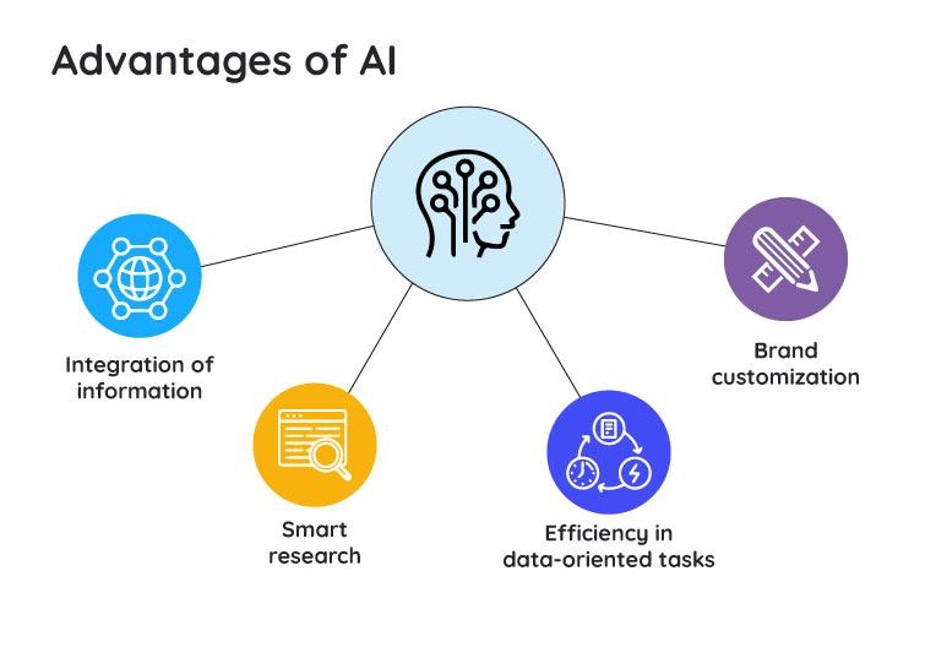
1. Increased Productivity
AI tools can automate repetitive tasks like data entry, scheduling, and reporting. This allows people to focus on creative and strategic work.
Real-life example:
A digital marketer uses AI tools to generate ad copies, analyze campaign performance, and schedule posts—cutting work time in half.
2. Cost Efficiency
Hiring multiple professionals can be expensive. AI tools often provide similar support at a fraction of the cost.
Example:
A startup uses AI tools for logo design, content writing, and customer support instead of hiring full-time staff.
3. Improved Accuracy
AI tools reduce human error, especially in data-heavy tasks like analytics, forecasting, and medical diagnostics.
4. Faster Decision-Making
By analyzing large datasets quickly, AI tools provide insights that help businesses make smarter decisions.
5. 24/7 Availability
Unlike humans, AI tools don’t get tired. They can work continuously without breaks.
Popular Categories of AI Tools
1. AI Tools for Content Creation
These tools help generate written content, summaries, scripts, and ideas.
Uses:
- Blog writing
- Email drafting
- Social media captions
- Product descriptions
Real-life use:
A blogger uses AI tools to generate article outlines and ideas, then adds a personal touch before publishing.
2. AI Tools for Image & Design
AI-powered design tools can create images, logos, banners, and social media posts.
Uses:
- Graphic design
- Branding
- Marketing creatives
Real-life use:
A small business owner creates Instagram posts using AI tools without hiring a designer.
3. AI Tools for Video & Audio
These tools help create videos, edit clips, generate voiceovers, and even clone voices.
Uses:
- YouTube videos
- Reels & shorts
- Podcasts
- Online courses
Real-life use:
An online coach uses AI tools to turn blog content into video lessons automatically.
4. AI Tools for Business & Productivity
These tools assist with task management, automation, and communication.
Uses:
- Meeting summaries
- Workflow automation
- CRM management
- Customer support chatbots
Real-life use:
A company uses AI chatbots to answer customer queries 24/7, improving response time.
5. AI Tools for Data Analysis
AI-powered analytics tools help process large datasets and find patterns.
Uses:
- Sales forecasting
- Market research
- Financial analysis
Real-life use:
An e-commerce brand uses AI tools to analyze customer behavior and improve product recommendations.
6. AI Tools for Education
AI tools personalize learning experiences for students and teachers.
Uses:
- Smart tutoring
- Assignment checking
- Learning recommendations
Real-life use:
A student uses AI tools to summarize textbooks and prepare for exams faster.
How AI Tools Work (Simple Explanation)
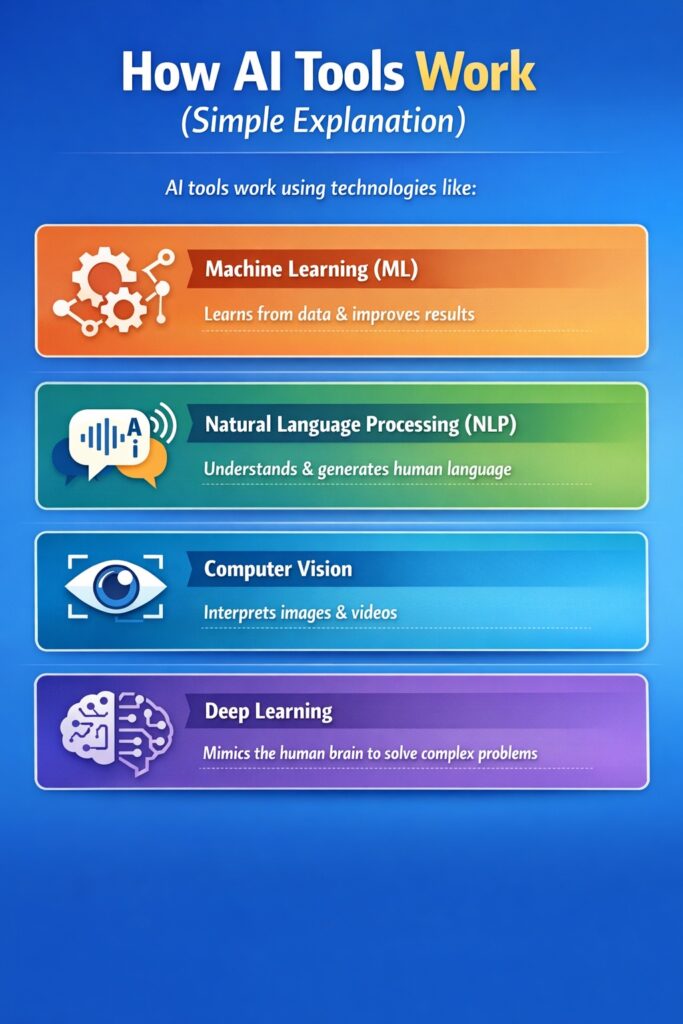
AI tools work using technologies like:
- Machine Learning (ML): Learns from data and improves results
- Natural Language Processing (NLP): Understands and generates human language
- Computer Vision: Interprets images and videos
- Deep Learning: Mimics the human brain to solve complex problems
You don’t need technical knowledge to use AI tools—the complexity works in the background.
Real-Life Uses of AI Tools in Daily Life
1. For Students
- Homework help
- Note summarization
- Research assistance
- Language learning
Example:
A college student uses AI tools to rewrite essays and check grammar before submission.
2. For Professionals
- Resume building
- Email writing
- Presentation creation
Example:
A manager uses AI tools to prepare reports and meeting summaries.
3. For Content Creators
- Script writing
- Thumbnail design
- Video editing
Example:
A YouTuber uses AI tools to generate video ideas and optimize titles.
4. For Businesses
- Customer support
- Marketing automation
- Inventory prediction
Example:
An online store uses AI tools to recommend products based on user behavior.
5. For Healthcare
- Medical image analysis
- Patient monitoring
- Diagnosis assistance
Example:
Doctors use AI tools to detect diseases earlier using imaging data.
AI Tools and the Future of Work

There is a common fear that AI tools will replace human jobs. In reality, AI tools are more likely to change jobs rather than eliminate them.
- Repetitive jobs may reduce
- Creative and strategic roles will grow
- New roles like AI trainers and AI managers will emerge
AI tools are best seen as assistants, not replacements.
Ethical Use of AI Tools
While AI tools offer huge benefits, ethical use is important.
Key considerations:
- Data privacy
- Avoiding misinformation
- Human oversight
- Transparency
Responsible use ensures AI tools help society instead of harming it.
How to Start Using AI Tools
If you’re new to AI tools, follow these steps:
- Identify your need (writing, design, automation, etc.)
- Start with free AI tools
- Learn through tutorials and practice
- Combine AI output with human creativity
- Upgrade to paid tools if needed
Common Myths About AI Tools
❌ AI tools are only for tech experts
✔ Anyone can use them
❌ AI tools replace creativity
✔ They enhance creativity
❌ AI tools are expensive
✔ Many powerful tools are free or affordable
Tips to Get the Best Results from AI Tools
- Give clear instructions (prompts)
- Review and edit AI-generated content
- Don’t rely 100% on AI—add human judgment
- Use AI tools ethically and responsibly
Conclusion
AI tools are transforming the world faster than ever before. From simplifying daily tasks to enabling innovation across industries, they are becoming essential for students, professionals, creators, and businesses alike.
The real power of AI tools lies in how we use them. When combined with human creativity, critical thinking, and ethics, AI tools can unlock opportunities that were once unimaginable.
Whether you want to save time, boost productivity, or explore new creative possibilities, now is the perfect time to start using AI tools and be part of the future.